Showing posts with label Brigham Larson Piano. Show all posts

Tuesday, June 3, 2014

Plastic Elbow Replacement (For Spinet Pianos)

Plastic Elbow Replacement


Many spinet pianos manufactured during the 1950’s and 1960’s  were outfitted with plastic parts which after decades of use begin to weaken and break.  One of the most common of plastic parts to fail is what’s known as an elbow-an integral part of many spinets.


If the elbows in your spinet are beginning to break, I would suggest having a professional piano technician install a complete set of high-quality snap-on drop lifter elbows to fix the problem for once and for all.


The reason the elbows begin to break in the first place is when the spinets were manufactured in the 1950’s plastic parts were just beginning to make their way into many small pianos.  The benefit of long-term observation of the durability of plastics was not yet available, and certain characteristics of the plastic formulations being used at the time would not be realized for years to come. The quality of the plastic just wasn't as good as the plastics today.  One problem with these older plastics is the chemical which was put into the mixture of the plastic to solidify the part would eventually harden the plastic to the point of brittleness.  Elbows are subjected to continuous stress every time the piano is played. Breakage begins to occur when a set of elbows have turned brittle with age.


So should you replace just the broken plastic elbow?  My advise is even if only a few elbows are broken, you should replace the entire set.   More elbows will break over time and you will have to have your piano fixed over and over again.  Imagine you purchased an automobile with a set of bald tires. One tire blows out and must be replaced.  Would it be wise to replace the other three at the same time?  Certainly it would, because the other three would be near the end of their useful life as well. Whether the remaining bald tires would fail or not would not be the question, only when. The original elbows which still remain these spinets will continue to break if they are not replaced.  Only by the installation of a new set of elbows may the problem be fixed on a permanent basis.  


The first step in installing new elbows is to break each elbow off close to the wooden wippen, the part in the lower area of the piano action which the elbow connects to.  The old elbows were connected to the wippen with a brass pin, which the new snap-on plastic elbows will be connected to.  Before that may be done, however, the remaining portion of the old elbow must be carefully broken away and removed from the wippen.  This is a delicate step and one that calls for an experienced hand.  If too much pressure is applied in breaking away the remnants of the old elbows, the thin wooden wings on either side of the slot in the wippen may be easily broken.  If this happens, it greatly compounds the amount of work which needs to be done.  Fixing broken wippens is a more serious problem, often requiring the removal of the action from the piano.  This is a repair that needs to be done by an experienced piano technician.  

After the remnants of the old plastic elbows are broken away from the lifter wires, the new Snap-On elbows are individually screwed onto the threaded lifter wires to an exact depth.  The lifter wires with the new elbows attached are then re-installed in the piano.  Working from underneath the key bed, the buttons are positioned in the slot at the back of the keys, and the new elbows are firmly snapped into place on the brass center pins of the wippens.  

Once the lifter wires with attached elbows have been installed, adjustments will need to be made to the amount of ‘lost motion’ that each is now given to prevent hammers from either bubbling or from blocking up against the springs.  With new elbows installed, and regulation buttons adjusted, all hammers are ready to fire.


If you have an older spinet piano that is starting to have problems with the plastic elbows breaking, please give us a call at 801-701-0113 or visit us at brighamlarsonpianos.com.  Our piano technicians can fix the problem once and for all.  We also do other piano repairs and tunings and offer trade-in’s if you would like to upgrade the upright or grand piano you already have! Maintaining your piano with properly done repair work will help you to enjoy playing your instrument for years to come!
#piano#pianorepair

Thursday, May 15, 2014

What is piano regulation and how can it help my piano sound great again!

For the serious pianist, the touch of a piano is just as important as the tone of the piano.  When a piano begins to lose it's efficiency and responsiveness in the mechanical action of the piano, it is said to have gone “out of regulation.” This means adjustments that were set at the factory no longer are accurate.   A regulation involves three systems in your piano: the damper, the action, and the trapwork..  A regulation will put the action parts of your piano back in the proper relationship with each other and the rest of the piano so it can operate at its maximum potential again.


Here’s a list of the many moving parts that occasionally need to be regulated.
  • Tighten screws (reduce clicking, rattling, or buzzing noises coming from your piano, makes for smoother playing)
  • Pedal Adjustment (helps make dampers more effective, makes your piano more responsive to pedal input)
  • Aftertouch (nice solid, crisp, responsive feel to the keys, can help with sticking keys)
  • Let-off (reduce mushy feel, maximize dynamic expression, eliminates double striking or hammers stifling the sound, most frequent cause of sticking keys)
  • Damper Alignment & Lube (stop pesky notes that still ring after you let up on the sustain pedal)
  • Key Dip (how far you can push the keys down, helps to smooth repeat playing)
  • Key Spacing & Leveling (does your piano need braces? significantly improves appearance, can help with sticking keys)
  • Hammer Blow Distance (distance from resting position to the strings, gives you more power)
  • Action Height (facilitate smoother, quieter soft pedal operation)
  • Key Height (how high the top of the keys are, gives you more power, quicker repeat playing)
(list taken from enjoyyourpiano.com)

So if you are noticing sticky keys on your upright or grand piano, keys that are not level, hammers double bouncing, or an unevenness of touch and tone, call us at 801-701-0113  to schedule a regulation or a piano tuning by one of our expert piano technicians!  You can also visit our website at brighamlarsonpianos.com. We would love to help you get the touch of your piano feeling great again! Or, if you are ready to upgrade or trade in your used piano to a new one, we offer many options.  We are Utah’s exclusive Hailun Piano Dealer!  
#piano #pianorepair

Tuesday, May 13, 2014

Hammer Head Filing

Hammer Head Filing


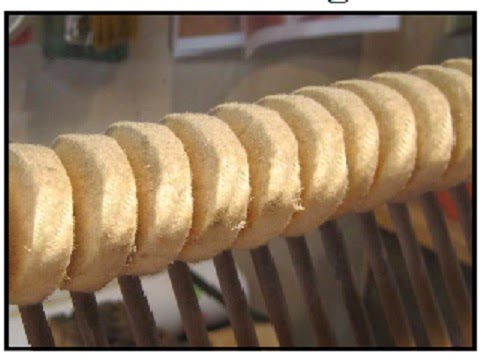
How are the hammer heads on your piano looking lately?  The hammer heads on a piano are much like the mallets used to play a xylophone, except that all 88 notes in your piano have a separate "mallet" or hammer.


The hammerheads on a piano receive more punishment than any other part of the piano action. If the hammer heads on your upright or grand piano have deep grooves and cuts from many years of heavy playing they may need filing.   This is one of many repairs we do here at Brigham Larson Pianos!   
So, what happens when your hammer heads are worn? Instead of delivering a clean blow to the strings upon striking, they will wrap around the strings producing a poor tone. It would be like an accomplished violinist trying to play her instrument while wearing a mitten on her left hand.  Shown below to the left is a worn hammer head.  See the deep groves? On the right is a well-functioning hammer head.

Getting your hammer heads filed will result in a much cleaner, crisp tone.  This repair could either be done at your home or our shop here in Pleasant Grove.  It requires moving the action (working part) of your upright or grand piano and gauging how much felt from the hammers would need to be removed. Then the hammers would be re-shaped by sanding them with a strip of sandpaper (as shown in the below picture.) After this, the hardness of the hammers would be adjusted to get the best tone possible.  
If you would like to learn more about hammer head filing, or would like to schedule a piano tuning or repair from one of our expert pianos technicians, please give us a call at 801-701-0113 or visit our website at brighamlarsonpianos.com.  We would love to discuss the best maintenance program for you and your pianos to get it sounding its very best!